5. The engine
The fifo stage of chapters 3 and 4 served one turn at a time, start to
finish. No LLM engine works like that. A real engine runs iterations: each
one hands a token budget to the requests already running — one token to each
decoding request, a chunk to each prefilling one — and then admits waiting
requests with whatever budget is left. Prefill and decode are not phases. They
are the same iteration.
vLLM's scheduler puts it plainly: there is "no decoding phase nor prefill phase". serQ has one stage kind for this, and it is the one the lecture's language could not express.
The program
// Chapter 5: the engine.
// The `fifo` stage of chapters 3 and 4 served one turn at a time. A real
// LLM engine runs *iterations*: every iteration hands a token budget to the
// requests it is already running — one token to each decoding request, a
// chunk to each prefilling one — and then admits waiting requests with
// whatever budget is left. Prefill and decode share the same iteration.
let B = 2048;          // token budget per iteration (max_num_batched_tokens)
let max_seqs = 16;     // how many requests may run at once
let blocks = 4000;     // KV blocks
let bs = 16;           // tokens per block
let alpha = 2e-5;      // compute per scheduled token (s)
let omega = 2e-4;      // weights read per iteration (s)
let beta = 2e-9;       // KV read per iteration per resident token (s)
let Lambda = 0.5;
let p = 0.8;
let Z = 3.0;

pool kv { cap blocks * bs; block bs; evict lru; preempt lifo; }
pool reqs { cap max_seqs; admit via engine; }

stage engine : step {
  budget B;
  // an iteration costs whichever is larger: reading the weights and the
  // residents' KV, or computing the tokens it scheduled
  cost max(omega + beta * (kv_decode + kv_prefill), tokens * alpha);
  memory kv;
}
stage tool : delay;

workload {
  arrive poisson(Lambda);
  init { set K = 0; }
  turn {
    set n = K == 0 ? ~uniform(1000, 3000) : ~exp(500);
    set o = ~exp(200) + 1;
  }
}

session {
  turn;
  loop {
    set t0 = now;
    set prompt = K + n;
    // how much of the prompt the cache could supply, in whole blocks. The
    // cache itself is read inside the hold's units, so it is read when the
    // request is admitted -- while it waits, its prefix is still evictable
    set hitmax = floor((prompt - 1) / bs) * bs;
    hold reqs (1), kv (min(prompt, hit + budget_left(engine)))
         at admission (hit = min(cachedin(kv), hitmax)) {
      set c = min(cached, floor((prompt - 1) / bs) * bs);
      observe hit = c > 0;
      run engine prefill (prompt - c) growing kv;
      observe ttft = now - t0;
      run engine decode (o - 1) growing kv;
    } cache (prompt + o);
    observe response = now - t0;
    set K = prompt + o;
    branch with (p) { run tool (~exp(Z)); turn; } else { drop kv; end; }
  }
}

run { horizon 20000; warmup 2000; seed 1; }
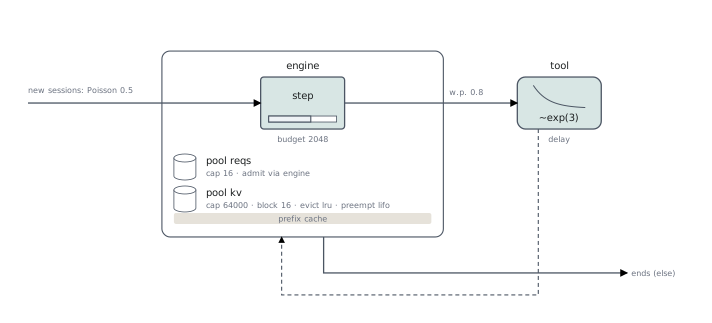
Its deployment, drawn by serq draw:
The step stage
stage engine : step {
  budget B;
  cost max(omega + beta * (kv_decode + kv_prefill), tokens * alpha);
  memory kv;
}
budget is the tokens one iteration may schedule (max_num_batched_tokens).
cost is how long the iteration takes, as an expression in what it scheduled:
| Variable | Meaning |
|---|---|
tokens |
tokens scheduled this iteration |
decoders |
decoding residents scheduled |
prefilled |
prefill tokens scheduled |
residents |
residents, scheduled or not |
kv_decode, kv_prefill |
memory held by the scheduled decode / prefill residents |
attention |
attention work of the prefill chunks, \(\sum n(K + n/2)\) |
The cost above is the standard roofline: an iteration takes either the time to
read the weights and the residents' KV, or the time to compute the tokens it
scheduled, whichever is larger. On an A100 with Qwen3-8B, fitting
c + d·decoders + e·kv_decode + a·prefilled + b·attention to 3 022 measured steps gives a MAPE of
2.7 % for decode and 5.6 % for prefill — the cost expression is where a real
measurement enters the model.
Other options: chunk caps one request's prefill chunk
(long_prefill_token_threshold), and serve names the one order the
iteration serves its residents in: serve admission (vLLM's running list,
the default), serve by (keys) (ascending keys per resident, from
decoding, admission and remaining; serve decode first is
serve by (decoding ? 0 : 1)), or serve exclusive prefill (a prefill
chunk runs alone and stalls every decode, the RBLN stack).
Three new pieces of the session program
set hitmax = floor((prompt - 1) / bs) * bs;
hold reqs (1), kv (min(prompt, hit + budget_left(engine)))
     at admission (hit = min(cachedin(kv), hitmax)) {
  run engine prefill (prompt - c) growing kv;
  run engine decode (o - 1) growing kv;
} cache (prompt + o);
growing kv — the request does not take all its memory up front. It is
admitted with the blocks for the chunk it can run now, and grows block by
block as it decodes. When growth finds no free block, preempt lifo throws
out the most recently admitted request: its blocks are freed to the cache, it
goes back to the head of the queue, and it recomputes what it lost. That is
vLLM's _preempt_request, and in serQ it is just "abort the scope and re-run
the statement" — which is what made hold a scope in chapter 2.
budget_left(engine) — how many tokens the next iteration leaves after
its residents. The admission asks for the hit's blocks plus the chunk that
budget can take now.
Both are read when the request is admitted, not when it queues — the rule
chapter 2 flagged, and this is the program that needs it. That is why
cachedin(kv) appears inside the units rather than in a set above them: a
set would read the cache while the request was still queueing, and a waiting
request's prefix is exactly what is still evictable. at admission (hit = …)
is where a header names what it is written in terms of — the parser
substitutes it, so the program that uses it and the program that inlines by
hand have the same IR.
The units then read min(prompt, hit + budget) — the whole prompt, or as far
as the hit and the budget reach, whichever is less.
admit via engine on a pool (reqs in the program above, and in
examples/replay/vllm_replay.sq) hands the pool's queue to the engine's
scheduler: waiting requests are admitted at the start of an iteration, with
the budget left, and never in an iteration that preempted.
Running it
run: horizon 20000 end 20000 warmup 2000 seed 1 events 9212861 arrivals 9905 ended 8903 turns 43947 mean live 5.977

observe   count    mean   95% CI    cv2     p99
--------  -----  ------  -------  -----  ------
hit       43947  0.7927  ±0.0040  0.262  1.0000
ttft      43947  0.0181  ±0.0007  1.276  0.0798
response  43947  0.0633  ±0.0011  0.645  0.2429

stage   number   util   done    thru    wait  service    iters
------  ------  -----  -----  ------  ------  -------  -------
engine   0.153  0.138  87894  4.8830  0.0000   0.0313  9164050
tool     5.822  0.998  35044  1.9469  0.0000   2.9903        0

pool   used   cached  queue  holders    wait  admits  evict(n)  evict(u)  preempt  spill  rej  stuck
----  -----  -------  -----  -------  ------  ------  --------  --------  -------  -----  ---  -----
kv    729.8  28515.4  0.000    0.153     NaN   48810       218   1760208        0      0    0      0
reqs    0.2      0.0  0.002    0.153  0.0007   48810         0         0        0      0    0      0
9 164 050 iterations. That is what step costs you: the engine is
simulated iteration by iteration, and at ~2 ms each a 20 000-second horizon is
nine million of them. Nothing else in serQ is this expensive.
done 87894 at the engine against 43 947 turns — two runs per turn, prefill
and decode.
TTFT is now separately observable, and at 18 ms it is a different quantity from the 63 ms response. Separating them is the whole reason to model the engine at iteration granularity instead of as one service time.
wait NaN on the kv pool
A hold on several pools joins the queue of the first one, so kv never
has a queue of its own and its mean wait is 0/0. Cosmetic; the queueing is
all on reqs.
Next: turn the load up. → The cliff